 Image 1 of 1
Steve
Year: 2026
Size: 8.5 × 11 inches
Medium: Watercolor
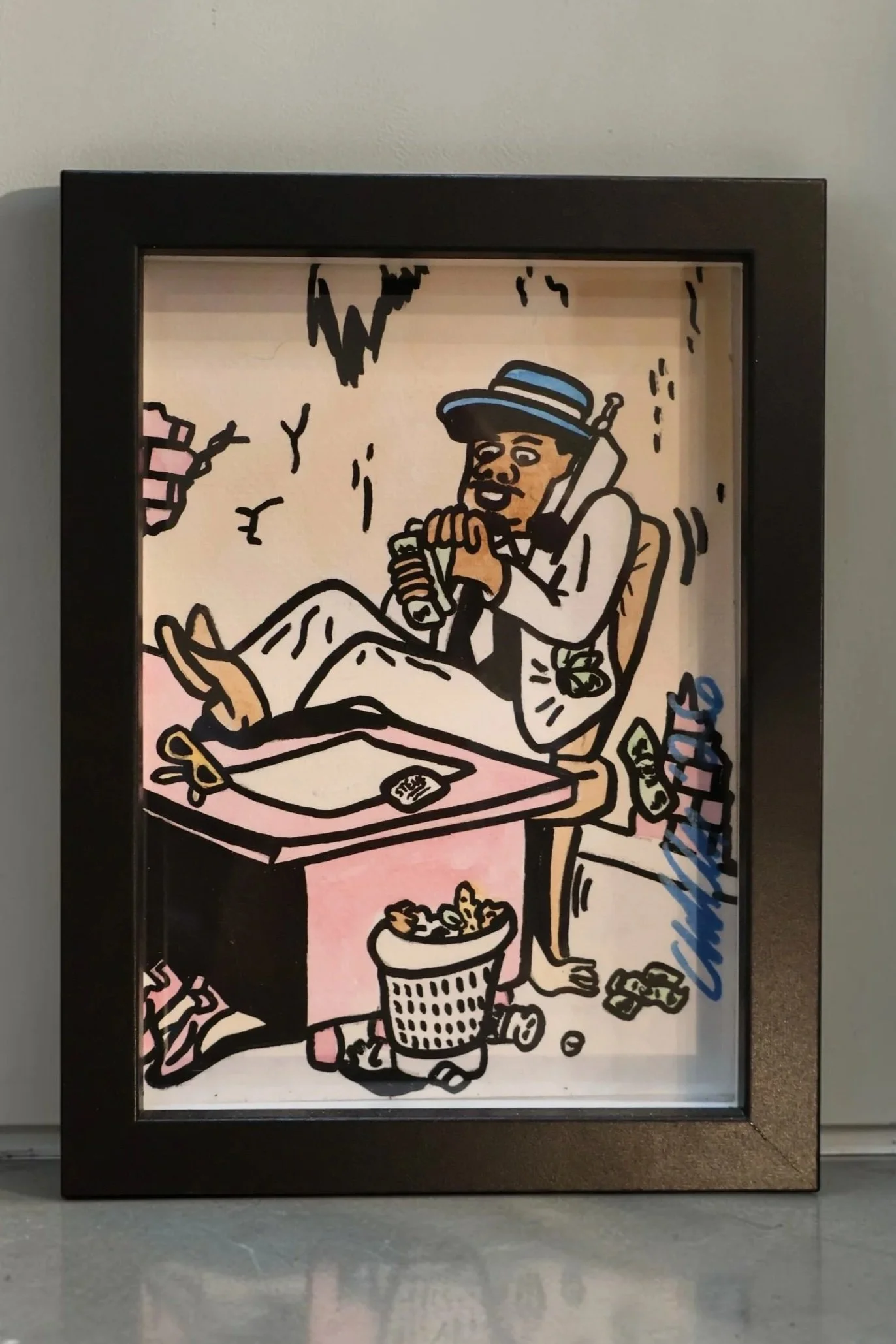
Steve is a portrait of one of my closest friends and someone whose confidence, independence, and ambition I deeply admire. He sits behind a desk in a crisp white suit, surrounded by money and symbols of success. His relaxed posture suggests that he does not need to chase attention or prove that he belongs. He already understands his value.
I imagine Steve as a pimp, but not in the literal sense of exploiting or controlling women. Here, the word represents a particular kind of presence. It is the energy behind calling someone “pimp” as a term of respect: an alpha, a leader, and a person who moves through the world according to his own rules. He is someone who understands the game around him without allowing that game to control him.
Money appears throughout the painting because Steve is unapologetically driven by financial success. He protects his own interests and refuses to build his life around the expectations, opinions, or emotional demands of other people. Some may interpret that mindset as selfishness, but I also see it as discipline. His focus allows him to invest in himself, strengthen his identity, and create a life that belongs entirely to him.
That quality is part of what I admire most about him. I often spend energy worrying about how other people feel, what they may think of me, or whether I am giving enough of myself to them. Steve represents the opposite impulse. He reminds me that caring about yourself does not always require an apology. There is power in knowing when to choose your own well-being, your own future, and your own name.
His white suit carries meaning beyond fashion. Against the identity of a Black man in America, the color becomes a visual statement. White has traditionally symbolized purity, wealth, ceremony, and innocence, but it can also represent visibility. A Black man wearing white cannot easily disappear into the background. He becomes the center of the image and occupies that position with confidence.
The contrast between his skin and the suit also confronts the way people judge him before knowing him. Society may attempt to reduce a Black man with money, confidence, and authority to a stereotype. His appearance may cause others to assume that they understand his character, his motives, or how he achieved his position. The painting challenges that judgment by presenting the stereotype first and then asking the viewer to look deeper.
Steve’s white suit does not claim that he is perfect. Instead, it reflects how I understand his heart beneath his hard exterior. He may appear detached, materialistic, or unconcerned with anyone beyond himself, but the person I know is more complicated than the image others may create from his surface. The white becomes a symbol of the part of him that remains untouched by those assumptions.
The suit also makes him appear almost untouchable. White clothing is difficult to keep clean, especially in a world that constantly tries to leave its mark on people. Steve wears it comfortably, as though the disorder surrounding him cannot reach him. Money may be scattered across the floor and the room may feel chaotic, but he remains composed. The world around him is messy, yet his identity stays intact.
The desk separates Steve from the viewer and gives him a position of authority. His feet rest casually across it, suggesting ownership of the room and freedom from ordinary expectations. He is not sitting upright to appear respectable. He does not perform humility to make others comfortable. His posture communicates that he has already claimed his space and does not need permission to remain there.
At the same time, the painting is not simply a celebration of money or emotional detachment. It reflects my fascination with a person who has learned to place himself first in a world that often asks people to sacrifice their identity for acceptance. His self-focus can appear harsh, but it also protects the individual he has worked to become.
Steve is ultimately a portrait of admiration. It captures the version of my friend that exists in my imagination: powerful, financially driven, sharply dressed, and entirely secure in who he is. He represents a kind of individualism I want to develop within myself. I do not want to become a copy of him, but I want to learn from his ability to protect his energy, believe in his worth, build his own brand, and remain focused on the life he wants.
People may judge Steve by his clothes, his money, his confidence, or the character they think he resembles. To me, he is far more than the cover they see. He is a man who belongs to himself.