 Image 1 of 1
Hidden Identity
Year: 2026
Size: 12 × 16 inches
Medium: Watercolor on paper
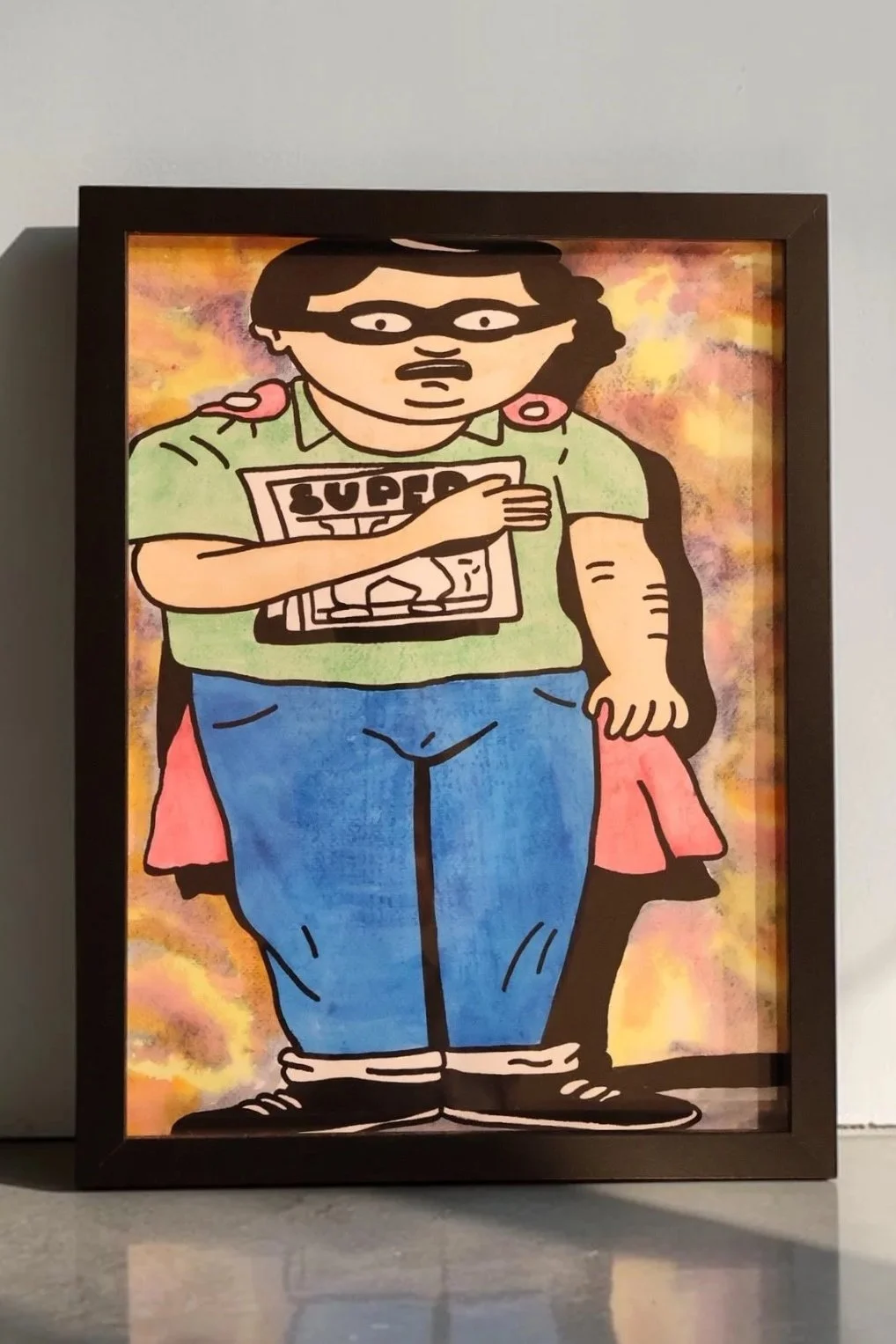
A young man stands dressed as a superhero, wearing a cape while holding a comic book tightly against his chest. His glasses, ordinary clothing, nervous expression, and slightly awkward posture contrast with the heroic identity he is attempting to create. He looks like someone pretending to possess extraordinary confidence while still appearing unmistakably human underneath the costume.
At first, the painting can be read as a playful image of a comic book nerd imagining himself as one of the heroes he admires. The costume is homemade rather than convincing. He does not have enormous muscles, an intimidating stance, or any obvious superpower. Instead, his most important possession appears to be the comic he is protecting against his chest.
That comic represents something personal to me: my love for anime and manga.
Anime is something I genuinely enjoy, but it is also something I tend to keep hidden. I do not always tell people that I watch it because I know how quickly people can make assumptions based on someone’s interests. Something as harmless as enjoying anime can become a label that changes the way another person sees you. Rather than risk being judged, misunderstood, or placed into a stereotype, it can feel easier to simply keep that part of myself private.
The superhero costume represents the identity we construct for other people. Superheroes traditionally use costumes to hide who they really are, but this character creates an interesting reversal. Instead of hiding an extraordinary person underneath an ordinary identity, he is an ordinary person using an extraordinary identity to protect something completely normal about himself.
His cape becomes a form of armor.
It allows him to appear confident, funny, exaggerated, or even ridiculous before anyone has the opportunity to discover what he actually cares about. Sometimes it feels safer to control the version of yourself that other people see than to allow them access to something genuine and risk having them reject it.
The comic being pressed against his chest is important for that reason. He is not casually holding it at his side or displaying it proudly for everyone to see. He holds it close to the part of his body associated with emotion and vulnerability. It becomes less like an object and more like a secret.
There is also irony in hiding a love for anime and manga because so many of those stories are themselves about identity. Characters disguise themselves, transform, discover hidden abilities, struggle with belonging, search for acceptance, and gradually learn what it means to become themselves. They may spend entire stories trying to understand who they are while the person watching those stories can simultaneously feel pressure to hide their connection to them.
The painting therefore becomes a portrait of two identities existing at the same time.
There is the person other people are allowed to see, and there is the person underneath.
The superhero represents the public version: constructed, controlled, and intentionally presented. The comic represents the private version: personal, vulnerable, and protected. Neither version is necessarily fake. The problem begins when maintaining one identity requires constantly hiding the other.
The character’s appearance also plays with stereotypes. The glasses, comic book, clothing, and awkwardness immediately encourage the viewer to categorize him as a “nerd.” That reaction is part of the painting. We constantly make assumptions about people from small pieces of visual information. Clothing, hobbies, music, jobs, interests, and even the things someone watches can become shortcuts we use to decide who we think that person is.
But no person can be completely understood through a stereotype.
Someone can love anime and still exist completely outside the personality others associate with anime fans. Someone can enjoy comics without wanting that interest to define them. Someone can be confident in most areas of their life while remaining strangely insecure about revealing one small thing they genuinely love.
That contradiction is what makes the character meaningful to me. His secret is not actually dangerous, shameful, or particularly shocking. He simply likes something.
Yet he treats that interest as though revealing it could expose him.
That exaggeration reflects how judgment can make harmless pieces of ourselves feel much larger than they really are. When we expect rejection, even a small personal interest can begin to feel like something requiring protection. We create costumes before anyone has even asked us to wear one.
The watercolor contributes to this vulnerability. Unlike the polished, powerful imagery normally associated with superheroes and comic books, watercolor can remain imperfect and visibly handmade. Colors bleed into one another, edges change in intensity, and the hand of the artist remains present. The medium does not completely conceal how the image was created.
In that sense, the watercolor works against the character’s attempt to hide.
He may be wearing a costume, but the painting itself refuses to become perfectly controlled.
The work also asks what it actually means to be confident. Confidence is often imagined as becoming fearless, impressive, or unaffected by other people’s opinions. But perhaps confidence can be much smaller than that. It can simply mean allowing yourself to enjoy something without needing to justify why you enjoy it.
The character does not need to transform into the superhero he is pretending to be.
He does not need powers.
He does not need everyone to understand him.
He only needs to become comfortable enough to stop treating an innocent part of himself like a secret identity.
Hidden Identity explores the distance between who we are, who we think other people want us to be, and the version of ourselves we create to survive between those two things. The superhero costume makes that conflict visible, but almost everyone carries some version of it. We change how we speak, dress, behave, or describe ourselves depending on who is around us. Some parts are displayed proudly while others remain protected.
The painting ultimately asks a simple question: if the thing underneath the costume is something you genuinely love, why should it need to remain hidden?
Maybe becoming the hero is not about creating a stronger alter ego.
Maybe it is having the courage to take the costume off.