 Image 1 of 1
Coward
Year: 2026
Size: 16 × 12 inches
Medium: Watercolor on paper
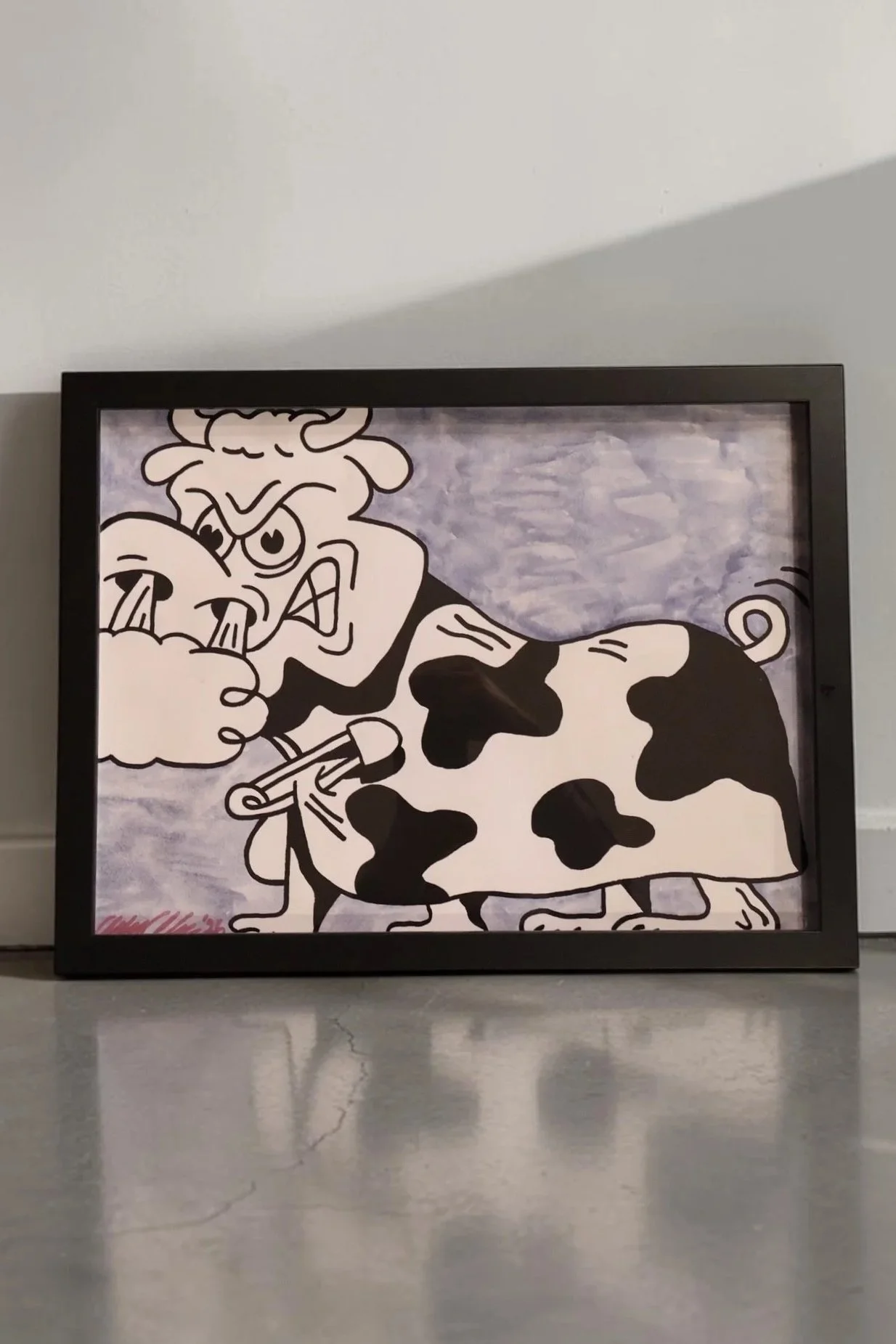
An angry bull hides inside the spotted body of a cow. At first glance, the animal appears familiar and harmless, but the disguise quickly begins to fall apart. An enraged face emerges from the costume with narrowed eyes, clenched teeth, and steam bursting from its nose. At the bottom of the painting, the bull’s real legs remain visible beneath the cow costume, revealing that the creature the viewer thinks they are looking at is not actually what it appears to be.
Even the title participates in the disguise. Coward contains the word “cow,” connecting directly to the costume, but its ordinary meaning describes someone who is afraid or unwilling to fight. The character underneath represents almost the exact opposite. He is not avoiding confrontation because he is afraid of it. He appears ready for one.
The painting reverses the familiar story of The Story of Ferdinand. Ferdinand looks exactly like the kind of bull people expect to fight. He is large and powerful, and the people around him assume those qualities must make him aggressive. Instead, Ferdinand would rather sit peacefully and smell flowers. He looks like a fighter but is actually a lover.
Coward turns that idea inside out.
This bull is a fighter pretending to be a lover.
Rather than possessing a threatening exterior that conceals a gentle personality, he places a harmless exterior over something aggressive. The cow costume allows him to appear softer, calmer, and less threatening than he really is. Someone looking only at the disguise could assume there is nothing to fear, while the expression emerging from it tells an entirely different story.
The difference between the cow and the bull therefore becomes more than a visual joke. They represent two different identities. The cow becomes associated with calmness, familiarity, passivity, and gentleness. The bull represents strength, anger, confrontation, stubbornness, and the willingness to fight.
The character understands the difference between those perceptions and uses them to his advantage.
His costume becomes a mask.
People do this too. We learn which parts of ourselves are acceptable to reveal and which parts make other people uncomfortable. We soften our personalities, control our expressions, change the way we speak, and sometimes make ourselves appear less intense than we actually are. A person can learn to look calm without feeling calm.
The bull has done exactly that.
He has changed how the world sees him without actually changing himself.
His anger has not disappeared simply because he put on the costume.
That distinction is important because hiding an emotion is different from resolving it. Anger can be covered by politeness, humor, silence, professionalism, or a smile, but covering an emotion does not necessarily make it disappear. Something can appear peaceful on the outside while remaining turbulent underneath.
The bull’s face makes that tension impossible to ignore.
He is trying to disguise himself as something gentle, yet he cannot completely conceal what he feels. His anger physically escapes the costume. His expression is visible. Steam leaves his nose. His actual legs appear underneath. The disguise works from a distance, but the closer the viewer looks, the more obvious the truth becomes.
Those exposed legs are one of the most important details in the painting.
They represent the pieces of ourselves that remain visible no matter how carefully we construct an identity. A person can change their clothing, behavior, vocabulary, posture, or surroundings, but maintaining a completely false version of oneself is difficult. Eventually, something underneath begins to show.
Sometimes it is intentional.
Sometimes it slips out.
Sometimes another person simply looks closely enough to notice.
The painting also leaves open the question of why the bull is hiding.
Perhaps he knows that people will judge him if they recognize how angry or confrontational he can be. Perhaps he has learned that appearing harmless makes life easier. Maybe the costume protects him from assumptions people would make if they saw a bull approaching them.
In that interpretation, the disguise is defensive.
But there is another possibility.
Maybe he wants people to underestimate him.
A harmless appearance can be comforting, and comfort can lower someone’s defenses. If the bull deliberately presents himself as gentle while knowing that he intends to fight, the costume becomes less about protection and more about deception.
That possibility makes the painting slightly uncomfortable.
The viewer cannot know whether the bull is hiding his aggression because he is trying to control it or because he is waiting for the right moment to reveal it.
He can be sympathetic.
He can also be dangerous.
Both possibilities exist inside the same costume.
That ambiguity creates another connection to Ferdinand. Ferdinand teaches us not to assume something is dangerous simply because it looks powerful. Coward asks us to consider the opposite: should we automatically assume something is safe simply because it looks harmless?
Appearance can mislead in both directions.
A frightening exterior can conceal gentleness.
A gentle exterior can conceal aggression.
The humor of the painting keeps that idea from becoming completely dark. The disguise itself is ridiculous. The bull has essentially put on a cow costume and expected everyone around him to accept it. There is something funny about how obvious the deception becomes once the viewer notices the legs sticking out underneath.
But the absurdity also reflects something very human.
People often believe their own disguises are more convincing than they actually are.
Someone may insist that they are fine while everyone around them can see that they are angry. Someone may attempt to appear confident while their behavior reveals insecurity. Someone can pretend not to care while everything they do demonstrates how deeply they care.
The costume may fool someone for a moment.
The details tell the truth.
The title Coward adds another contradiction. Calling this character a coward initially sounds insulting because everything about his expression suggests aggression. But perhaps hiding inside the costume is itself an act of fear.
If he is truly comfortable with being a fighter, why does he need to disguise himself?
That question complicates the title.
Maybe being willing to fight does not automatically make someone brave. A person can be aggressive and still be afraid of being seen. They can confront other people while avoiding confrontation with themselves. They can defend their identity while simultaneously hiding it.
The bull may therefore be powerful and frightened at the same time.
His greatest fear may not be another bull.
It may be being recognized.
The painting also challenges the assumption that anger itself is automatically bad. Anger can become destructive, but anger can also communicate that something matters. It can emerge from injustice, frustration, fear, betrayal, pain, or the need to protect oneself or someone else.
Being a fighter does not necessarily mean wanting violence.
A fighter can be someone who refuses to surrender.
The bull may represent aggression, but he can also represent determination, survival, resistance, and the willingness to defend what matters to him. The painting never tells the viewer what caused his anger, so we cannot determine whether it is justified simply by looking at his face.
We only know that it exists.
The watercolor medium creates another contradiction within the piece. Watercolor is often associated with softness, delicacy, transparency, and fluidity. Here, that traditionally gentle medium is being used to portray a character filled with tension and aggression.
In a way, even the material becomes part of the costume.
Something soft is being used to communicate something hard.
Something transparent is depicting someone attempting to hide.
The background and costume may initially attract the eye through their simplicity, but the emotional center remains the bull’s expression. He is trapped between revealing himself and maintaining the disguise. He wants to be perceived as the cow while looking completely incapable of pretending to be one.
That conflict can reflect the exhaustion involved in constantly performing an identity.
Pretending requires effort.
The longer someone hides an important part of themselves, the more energy is required to keep the costume in place. Eventually, the question becomes whether the disguise is actually protecting them or imprisoning them.
The cow costume surrounds almost the bull’s entire body.
What began as camouflage can also be viewed as confinement.
He has successfully hidden himself, but now he must live inside the thing he created to hide him.
Coward ultimately explores the difference between appearance and nature, gentleness and aggression, restraint and deception, and the identities people construct when they do not want the world to see everything underneath.
It takes the lesson of Ferdinand and reflects it backward.
Ferdinand looks like a fighter but chooses peace.
This bull looks peaceful but carries a fight inside him.
Neither character is exactly what the outside world assumes.
And perhaps that is what connects them most.
The painting asks the viewer not to stop at the costume. Look at the expression. Look at the feet. Look at what does not quite fit. Consider why someone might want to be mistaken for something they are not.
Most importantly, Coward questions whether hiding our nature actually changes it.
The bull can paint himself in spots.
He can surround himself with softness.
He can call himself a cow.
But underneath the costume, the bull is still there.