 Image 1 of 1
Adventure
Year: 2024
Size: 6 × 6 inches
Medium: Acrylic on canvas
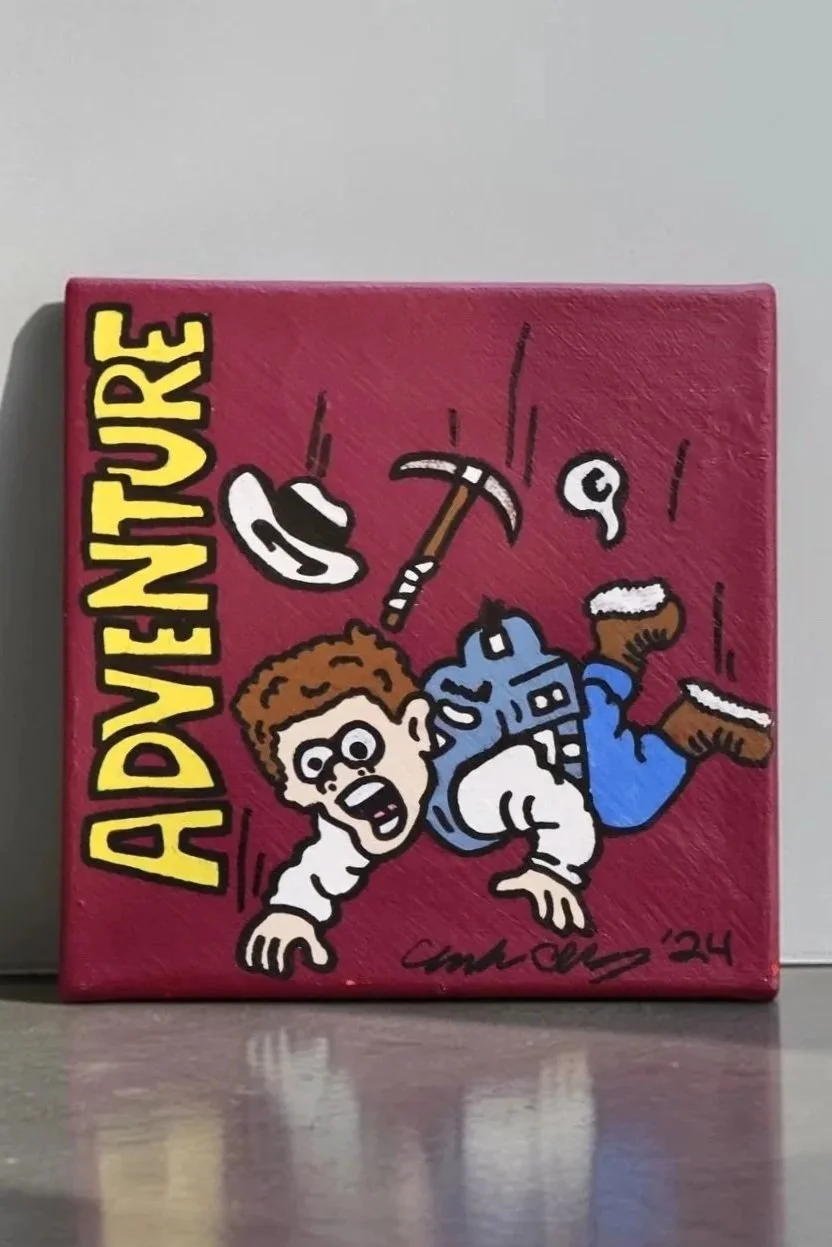
An explorer falls helplessly through the air as his hat, pickaxe, and belongings separate from his body. The word “ADVENTURE” appears beside him in large, cheerful yellow lettering, presenting the scene as though it were exciting and desirable. However, the figure is not discovering treasure or triumphantly reaching a destination. He is falling to his death.
That contradiction creates the satire at the center of the painting. Adventure is usually presented as something courageous, inspiring, and fun. People share photographs of beautiful destinations and exciting experiences, but rarely focus on the fear, confusion, danger, and loss of control that can accompany them. The painting takes the romantic promise of adventure and reveals the terrifying possibility hidden inside it.
The falling man appears dressed for exploration, but none of his preparation can save him. His equipment suggests that he intended to climb, search, and remain in control of his journey. Instead, every object that was supposed to help him has become useless. The pickaxe floats beyond his reach, his hat has left his head, and his belongings scatter around him. Preparation may reduce risk, but it can never guarantee an outcome.
His wide eyes and open mouth capture the instant when excitement becomes panic. He may have begun the journey believing he was prepared for the unknown, only to discover that the unknown does not care about his plans. The adventure has stopped being a story he controls and has become something happening to him.
The word “ADVENTURE” makes the moment feel almost like an advertisement. Its playful lettering promises entertainment while the image beneath it shows disaster. This reflects how adventure is often marketed: the experience is simplified into a bold word, an attractive photograph, or a heroic story. Fear is removed from the advertisement even though fear may be one of the most honest parts of the experience.
The painting also reflects my own fear of adventure. For me, leaving what is familiar can feel less like freedom and more like falling. A new place may offer discovery, but it also removes the routines and surroundings that create a sense of control. The mind can turn uncertainty into catastrophe before the journey has even begun.
Although I painted Adventure in 2024, its meaning became more personal when I traveled outside the country for the first time in 2026. Before that trip, part of me feared that something terrible might happen simply because I was leaving the world I understood. Traveling made me feel as though I were stepping beyond the edge of safety without knowing what would catch me.
I went anyway, and I did not die. That fact sounds obvious, but fear rarely behaves logically. Fear can make an ordinary journey feel like a life-or-death decision. It creates imaginary endings and asks a person to experience them before anything has actually happened. The falling explorer represents that version of my mind: the part that assumes uncertainty must end in disaster.
The painting does not suggest that every adventure is secretly fatal. Instead, it exaggerates danger to show how adventure can feel to someone who is afraid of it. Other people may see travel, exploration, and change as exciting. I can see the same opportunities and imagine everything that could go wrong.
There is also humor in the extremity of the scene. The man is not simply lost, delayed, or uncomfortable. He is dramatically falling with all of his equipment scattered around him. By turning anxiety into a cartoon disaster, the painting makes fear visible enough to laugh at. The exaggerated outcome exposes how irrational the imagination can become when it is trying to protect someone from uncertainty.
The falling motion also represents the loss of control required by any genuine adventure. A person can research, prepare, plan, and pack, but eventually they must enter a situation they cannot completely predict. Adventure begins at the point where certainty ends. For someone who depends on control to feel safe, that transition can feel indistinguishable from falling.
Yet the painting changed after my first international trip. The figure still falls, but I now understand that the sensation of falling does not always mean death is waiting below. Sometimes it means that I have left the ground and have not yet discovered where I will land. Fear may accompany the journey without accurately predicting its ending.
Adventure captures the darkly funny distance between what adventure looks like from the outside and what it can feel like internally. To the world, the figure is brave, active, and exploring. Inside his own mind, he is falling toward the worst possible outcome.
The painting is both a warning and a challenge to myself. Fear can make every unfamiliar experience appear fatal, but avoiding adventure creates another kind of loss. I survived the journey I was afraid to take, and that survival proved that fear is not always intuition. Sometimes fear is simply the mind calling something dangerous because it has never experienced it before.