 Image 1 of 1
Pop Culture
Year: 2024
Size: 6 × 6 inches
Medium: Acrylic on canvas
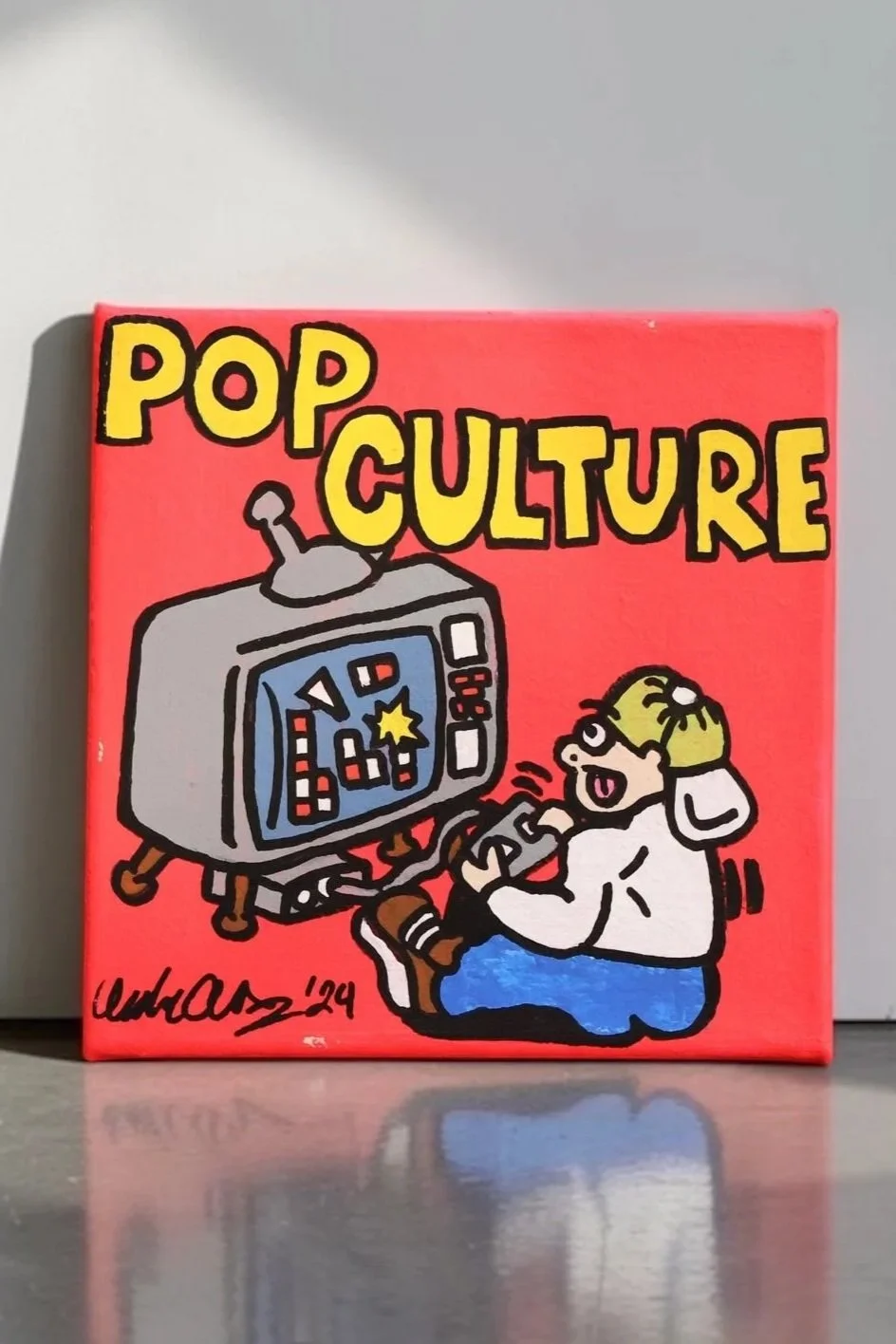
A young man sits on the floor in front of an old television, completely absorbed in a video game that combines two recognizable pieces of gaming history. A triangular spacecraft resembling the ship from Asteroids fires at falling, Tetris-style blocks. The game does not literally exist. It is a fictional combination of familiar imagery created to represent video games as a larger part of pop culture rather than one specific title.
The painting reflects my own relationship with gaming. Video games were once a more visible part of my lifestyle, played on consoles and televisions like the one shown here. I may not play them in the same way anymore, but gaming has never fully disappeared from my life. It has simply changed form. Now, much of that experience happens through my phone, making entertainment more portable, immediate, and constantly available.
The old television represents an earlier era when playing a game required someone to stop, sit down, and enter a separate world. The player is physically close to the screen, holding the controller with his full attention fixed on what is happening inside the television. His surroundings seem unimportant because, for that moment, the artificial world on the screen feels more urgent than the real one around him.
The imaginary game creates a conflict between order and destruction. Tetris is normally about arranging blocks into complete lines, turning disorder into structure. Asteroids is built around movement, survival, and shooting obstacles before they destroy the player. By combining the two, the painting transforms organization into combat. Instead of carefully placing the blocks, the player destroys them before they have the chance to land.
That contradiction reflects the way people often approach modern life. We are encouraged to build, organize, and make everything fit perfectly, while also being taught to eliminate anything that gets in our way. The blocks can represent responsibilities, trends, expectations, or pieces of information constantly falling toward us. The triangular ship becomes the individual attempting to survive by reacting faster than the world can overwhelm him.
The title Pop Culture refers not only to entertainment but also to the way culture continually appears, disappears, and reassembles itself. Video games, cartoons, television, technology, fashion, and advertising borrow from one another until their original meanings begin to blend together. The painting reflects that process by combining recognizable visual references into something new but immediately familiar.
The exaggerated lettering and bright primary colors resemble comic books, cartoons, advertisements, and children’s television. They make the image feel playful and nostalgic, but the phrase “pop culture” also becomes a label placed directly above the viewer’s experience. It is almost as though the painting is announcing what it represents before anyone has the opportunity to interpret it independently.
That obvious label is part of the satire. Pop culture often tells people what is important, what is entertaining, what should be remembered, and what deserves their attention. The player believes he is controlling the game, but the television may be controlling him just as effectively. While his hands operate the controller, the screen determines where he looks, how he reacts, and what he feels.
The large television and small seated figure emphasize the imbalance between the person and the entertainment consuming his attention. Although the player is outside the screen, his posture suggests that his mind has entered it. The game occupies the center of the composition, while the human being is pushed toward the edge. Technology becomes the dominant presence in the room.
At the same time, the painting does not condemn video games. Gaming can offer comfort, creativity, competition, nostalgia, and a temporary escape from ordinary life. The player’s expression shows genuine excitement. His enjoyment is not fake simply because it was created by a screen. The work instead considers how entertainment can be both meaningful and ridiculous, personal and mass-produced, harmless and consuming.
Pop Culture is a satirical self-portrait of a lifestyle shaped by screens. It remembers the period when video games were played in front of bulky televisions while acknowledging that the same habit continues through smaller devices today. The technology has changed, but the desire remains the same: to escape reality, control a world, and feel briefly capable of defeating everything falling toward us.