 Image 1 of 1
Year: 2024
Size: 5 × 7 inches
Medium: Paint marker on watercolor paper
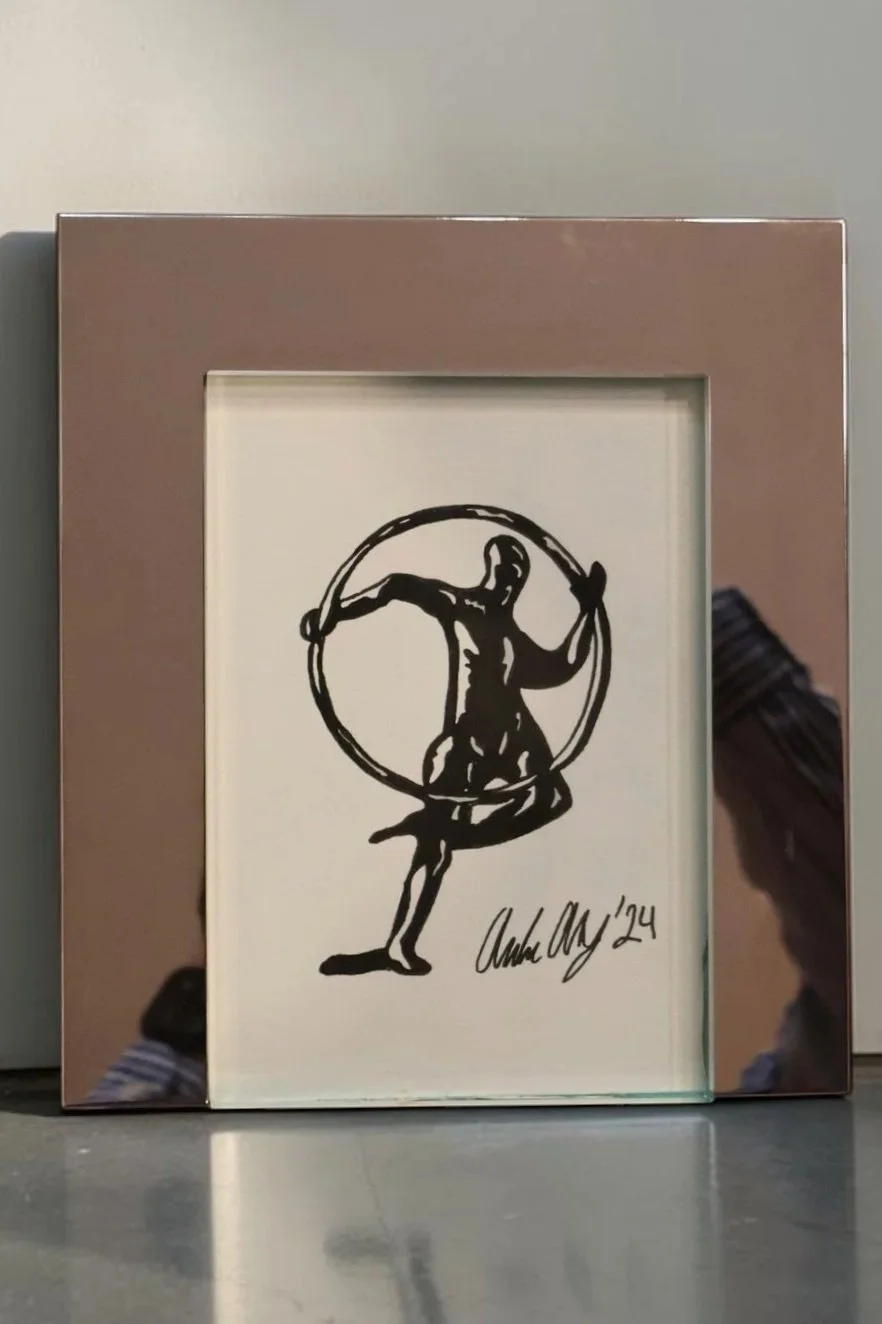
An abstract man stands inside a circle that he appears to hold open with both hands. At first, the object may look like a hula hoop caught in motion, transforming the scene into a simple study of the human body balancing, stretching, and moving through space. However, the circle can also be understood as a sphere, an opening, or a portal leading into another universe.
The figure’s body seems to exist both inside and outside the circle. One leg remains planted beneath him while the other crosses through the opening, leaving him suspended between two places. He has not completely abandoned the world behind him, but he has already begun entering whatever waits on the other side. His posture captures the exact moment when curiosity becomes action.
The circle represents possibility without revealing what that possibility contains. There is no visible landscape, destination, or promise inside it. The new world exists only through the figure’s willingness to believe that the opening leads somewhere. This uncertainty allows the circle to become whatever the viewer imagines: a better future, another reality, a forgotten memory, a new identity, or an escape from the limitations of the present.
Because the circle has no beginning or end, it can also represent repetition. The figure may believe he is entering an entirely different universe while unknowingly returning to a familiar pattern. What appears to be progress could become another cycle, suggesting that changing one’s surroundings does not always free a person from what they carry within themselves.
The man’s extended arms create another ambiguity. He may be controlling the circle, holding the portal open through his own strength, or struggling to prevent it from closing around him. The same object can therefore represent freedom and confinement. It offers him another world, but it also surrounds his body like a boundary.
His grounded foot remains outside the circle, connecting him to the reality he already knows. The leg crossing through the opening reaches toward uncertainty. Together, they suggest the conflict between security and transformation. Moving forward requires him to give up a stable position before he knows where the next step will land.
The lack of color and background removes the figure from any recognizable time or place. Nothing identifies the world he is leaving or the one he may be entering. This isolation turns the movement into something internal. The portal may not be a physical doorway at all, but a transformation taking place within the man himself.
Step Through explores the moment before a person becomes someone new. It asks whether another life is discovered or created, and whether crossing into it requires a doorway or simply the courage to move differently. The figure has not reached the other side yet. He remains balanced between fear and possibility, holding open a world that may exist only because he is finally willing to enter it.